 Gusset
Documentation › Materials
Materials
Every part needs a material before the study can be solved. It sets the stiffness, the weight and the yield strength that the factor of safety is measured against.
Assigning a material
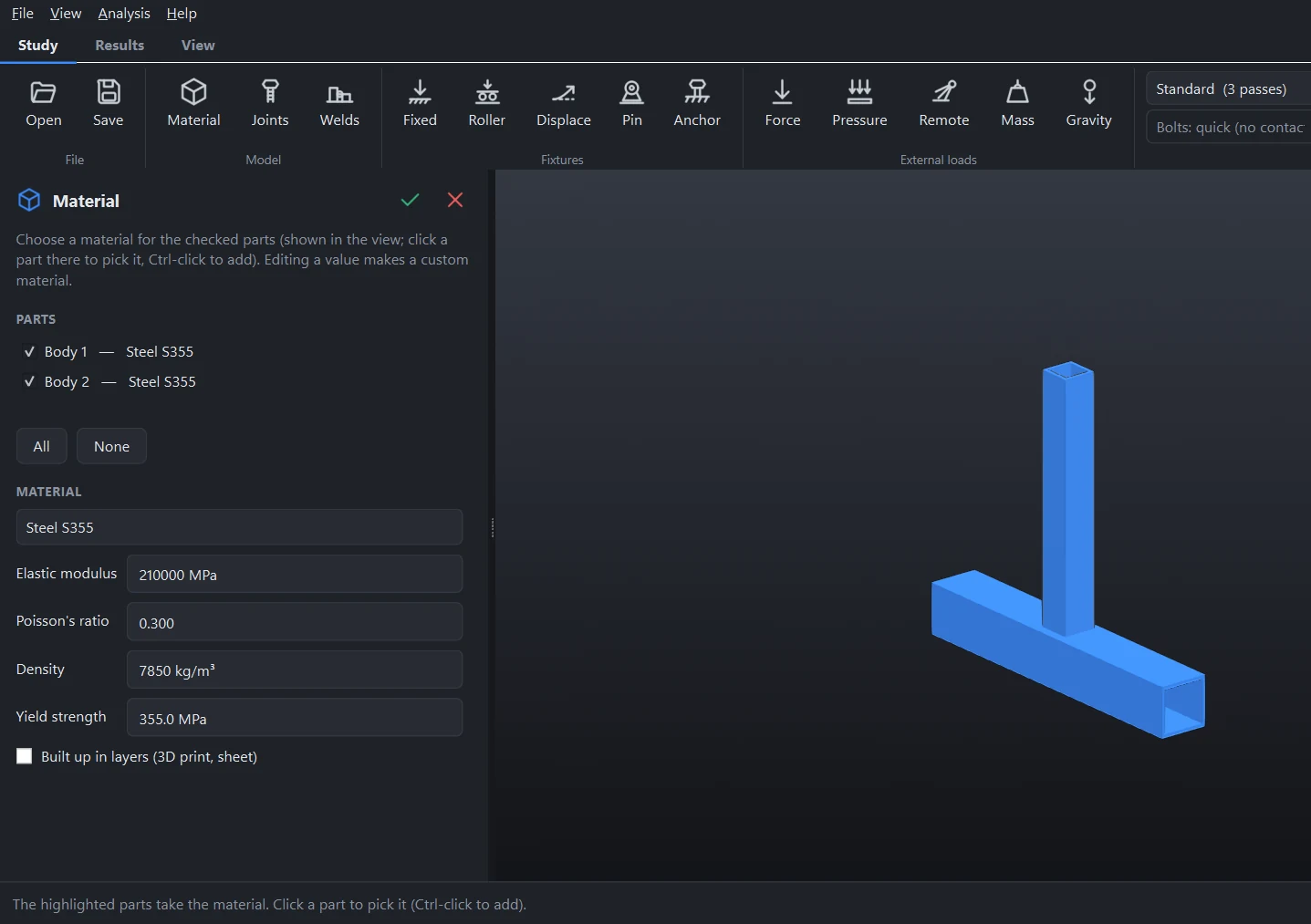
- Choose Material on the Study tab, or right-click a part and choose Material.
- Tick the parts it is for. They are lit in the view; a click on a part there picks it alone, and Ctrl-click adds it or takes it out. All and None tick or clear the list.
- Choose the material from the list and accept.
Built-in materials
| Material | Elastic modulus [MPa] | Poisson's ratio | Density [kg/m³] | Yield strength [MPa] |
|---|---|---|---|---|
| Steel S235 | 210,000 | 0.30 | 7850 | 235 |
| Steel S355 | 210,000 | 0.30 | 7850 | 355 |
| Plain carbon steel | 210,000 | 0.28 | 7800 | 220.6 |
| AISI 304 stainless | 193,000 | 0.29 | 8000 | 206.8 |
| Aluminium 6061-T6 | 69,000 | 0.33 | 2700 | 275 |
| Aluminium 6063-T6 | 69,000 | 0.33 | 2700 | 215 |
| Titanium Ti-6Al-4V | 114,000 | 0.34 | 4430 | 880 |
| Grey cast iron | 110,000 | 0.26 | 7200 | 150 |
Printed PLA, PETG, ABS and nylon are in the list too, with plywood and carbon fibre sheet marked experimental. They behave differently along and across their layers: see 3D prints and layered materials.
These are typical values. Check them against the certificate or data sheet for the material you are buying when the answer matters.
Your own material
Choose the nearest built-in material and change its numbers. Editing any value makes a custom material, named “Custom” and the name you started from, and it is saved with the study.
What the material is used for
- Elastic modulus and Poisson's ratio set how far the part deflects and how load is shared between parts.
- Density sets the mass in the summary table and the self-weight when gravity is on.
- Yield strength sets the factor of safety, and the limit a weld is checked against: the throat of a weld is compared with the shear yield of the weaker of the two parts it joins.
The analysis is linear: stress above yield is reported as it is calculated, and the material does not yield in the model. A factor of safety below 1 tells you the part would yield there, not what happens next.
Something wrong or missing on this page? Tell us.